A joke in a group chat. A conspiracy theory shared as a revelation. A Jewish colleague expected to answer for a government thousands of miles away.
Antisemitism can appear in ordinary interactions, including situations where the person repeating it does not recognize the prejudice involved. Learning to identify it gives us a chance to respond with clarity. [1]
I made Aliyah from the United States with my family when I was fifteen. My military service and work supporting new immigrants have shaped how I understand Jewish safety and belonging. They have also reinforced a responsibility: to speak carefully, listen honestly, and recognize the limits of my own perspective.
The seven examples below are illustrative scenarios, not accounts of specific incidents. They offer a starting point for recognizing familiar patterns and having better conversations.
Antisemitism is prejudice against or hatred of Jewish people. It can take the form of stereotypes, conspiracy theories, discrimination, harassment, or violence. The United States Holocaust Memorial Museum explains that it existed long before the Holocaust and continues today. [1]
Look at what someone says or does, who is being targeted, and the surrounding context. A useful question is: Is this person being judged for their own actions, or for being Jewish?
Imagine a colleague joking that a Jewish coworker should handle the budget because Jews are supposedly obsessed with money.
The problem is the assumption that Jewish identity determines someone's character. AJC's Translate Hate glossary identifies the association of Jews with greed as a longstanding antisemitic stereotype. Presenting that assumption as humor does not remove it. [2]
A person may repeat a familiar joke without understanding its history. That leaves room for explanation: 'That joke relies on a stereotype about Jewish people. Let's leave it out.' The response names the problem and gives the person an opportunity to change.|
Consider a video that claims a secret Jewish network controls the banks, news organizations, and governments. It may present a collection of Jewish names as if their identities establish a coordinated plot.
Claims of hidden Jewish control are a documented antisemitic conspiracy trope. The fact that some individuals hold influential positions does not establish collective control by Jewish people. [3]
Scrutiny of powerful people and institutions is legitimate. It should identify specific decisions, relationships, and evidence. If an argument depends on treating Jewish identity itself as proof of wrongdoing, that is a warning sign. Ask: 'What evidence supports this claim beyond the people being Jewish?'
Imagine a Jewish student being challenged about an Israeli military decision during a conversation that had nothing to do with politics. Nobody asks what the student believes; being Jewish is treated as enough to make them answerable.
Holding Jews collectively responsible for Israel's conduct is identified as antisemitic in the Jerusalem Declaration on Antisemitism. Jewish identity does not make someone a representative of the Israeli government. [4]
People can discuss Israeli policies, challenge arguments, and ask others about views they have actually expressed. They should not assign responsibility by ancestry or religion. A simple boundary is: 'You can ask what I think. Please don't assume I speak for a government.'
Picture a Jewish public servant whose loyalty to their country is questioned solely because they are Jewish, without any evidence of misconduct or a conflict of interest.
This reflects the antisemitic dual-loyalty accusation: the assumption that Jewish citizens secretly serve Israel or a separate Jewish agenda. AJC describes how this trope casts Jews as outsiders whose commitment to their own country cannot be trusted. [5]
Actual conflicts of interest deserve scrutiny using evidence and consistent standards. Jewish identity is not itself such a conflict. The question to ask is: 'Are we assessing this person's conduct, or making an assumption about their background?'
Imagine an organizer deciding not to invite a Jewish participant to a professional event because their presence might make others uncomfortable. The participant has done nothing objectionable; the objection is their identity.
Discrimination can involve access to jobs, services, education, or social and professional spaces. The Holocaust Museum documents exclusion from employment, institutions, and clubs among the forms anti-Jewish discrimination has taken. [6]
Inclusion should not depend on hiding a Jewish name, practice, or background. If there is a concern about someone's behavior, name the behavior and apply the same standard to everyone. 'What has this person actually done?' is a useful place to begin.
A social media comment claims that Jewish people invented or exaggerated the Holocaust to gain sympathy or power.
That claim combines historical falsehood with an accusation against Jews. The Holocaust was the systematic persecution and murder of six million European Jews by Nazi Germany and its allies and collaborators. Denial and distortion undermine the established historical record and can perpetuate antisemitism. [1] [7]
Honest historical questions belong in education. Claims that survivors fabricated their experiences should be answered with reliable documentation, including archival records, testimony, and museum resources. UNESCO emphasizes accurate historical knowledge and digital literacy as tools for countering denial and distortion. [8]
Imagine someone posting a family photograph from a Jewish holiday and receiving threats or Nazi imagery because the picture identifies them as Jewish.
The target is their identity and their right to express it. The IHRA working definition includes calls to harm Jews and the targeting of people or institutions because they are, or are perceived to be, Jewish. [9]
A person facing harassment does not owe the harasser a debate. Preserve screenshots and links, use blocking and reporting tools, and seek appropriate support. If there is immediate danger, contact local emergency services. When supporting someone targeted, ask what they need before sharing their experience publicly. [10]
Criticism of Israeli government policies is not automatically antisemitic. IHRA explicitly distinguishes criticism comparable to that directed at other countries from antisemitism. Supporting Palestinian rights is not, in itself, antisemitic either. [9] [4]
Look closely at the content and context: Does the criticism address a policy or action, or does it become a claim about Jewish people collectively? Does it introduce an antisemitic stereotype, assign collective guilt, or justify hostility toward Jews?
There are disagreements about some contested expressions and how definitions should be applied. Careful judgment helps us protect open debate while recognizing prejudice. [4]
Start with the situation in front of you. A thoughtless remark from a friend may call for a calm explanation. Repeated harassment may call for documentation, reporting, and disengagement. Respond proportionately and prioritize the person affected. [10]
In my advocacy, I try to follow a simple practice: ask a question, listen, and then respond. Listening helps me understand what someone means; it also gives me a better chance of explaining why a remark or action causes harm.
If you recognize something you have said or shared in these examples, you can correct it. Remove the post, acknowledge the mistake, and learn more. If someone else is targeted, offer support without making them responsible for educating everyone.
Jewish people deserve to participate in everyday life without having to defend their right to belong. Recognizing antisemitism is one practical way to help make that possible.
Join my email community for stories from Israel, perspectives on Jewish life, and practical ways to build understanding. Sign up below to receive new articles and updates.
Sources
United States Holocaust Memorial Museum - Antisemitism: An Introduction
American Jewish Committee - Translate Hate: Greed
American Jewish Committee - Translate Hate: Control
Jerusalem Declaration on Antisemitism - Definition and Guidelines
American Jewish Committee - Translate Hate: Dual Loyalty
United States Holocaust Memorial Museum - Antisemitism and the Holocaust
United States Holocaust Memorial Museum - Holocaust Denial and Distortion
UNESCO - Addressing Holocaust Denial and Distortion
International Holocaust Remembrance Alliance - Working Definition of Antisemitism
ADL and URJ - Responding to Antisemitic Incidents
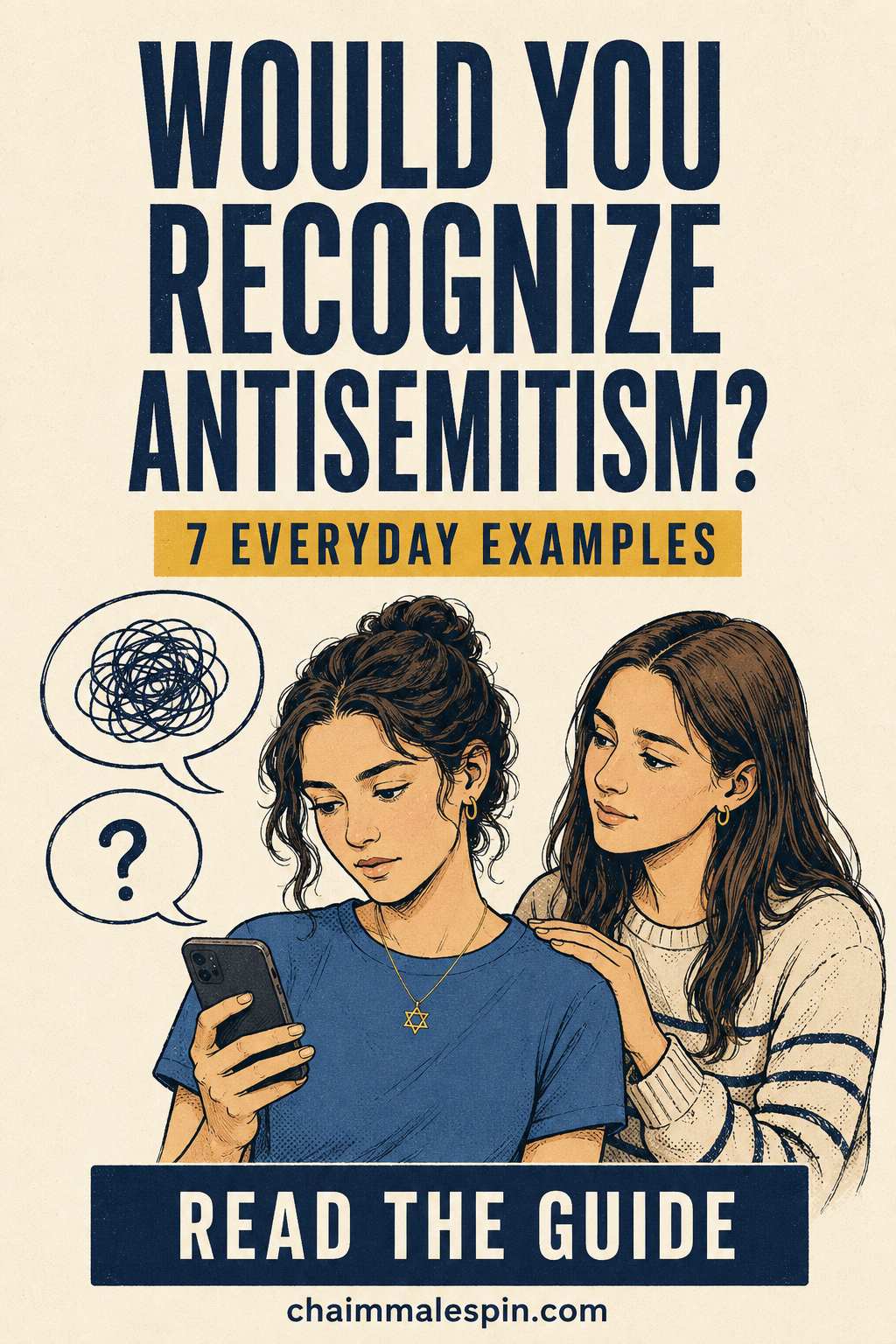
A familiar joke can carry an unfamiliar history. Learn how antisemitic stereotypes appear in everyday conversations and explore seven examples that help explain the difference between judging someone's actions and judging their Jewish identity.