You open your phone and see an antisemitic comment under a friend's post. A conspiracy theory is spreading in a group chat. Someone sends a threatening message to a Jewish student, business, or community organization.
The instinct to answer immediately is understandable. But the most effective response is not always the fastest or loudest one. Sometimes the right action is to correct misinformation. Sometimes it is to document, report, block, or step away. When there is a credible threat, safety comes first.
My work in advocacy has taught me that responding well requires both courage and judgment. We should speak clearly, but we should also listen, verify what we are seeing, and avoid giving hateful content more reach than it already has.
These seven steps offer a practical way to decide what to do next.
Before replying, ask what kind of content you are looking at. Is it an uninformed question, a false claim, a stereotype, coordinated harassment, or a direct threat? Those situations should not receive the same response.
Look at the account, the audience, and the pattern. A friend who repeats a familiar myth may be open to correction. An anonymous account posting dozens of slurs may be seeking attention and conflict. A message containing personal information, stalking, or a threat of violence requires a safety response—not a debate.
A short pause also reduces the chance that anger will lead you to share inaccurate information or escalate the exchange.
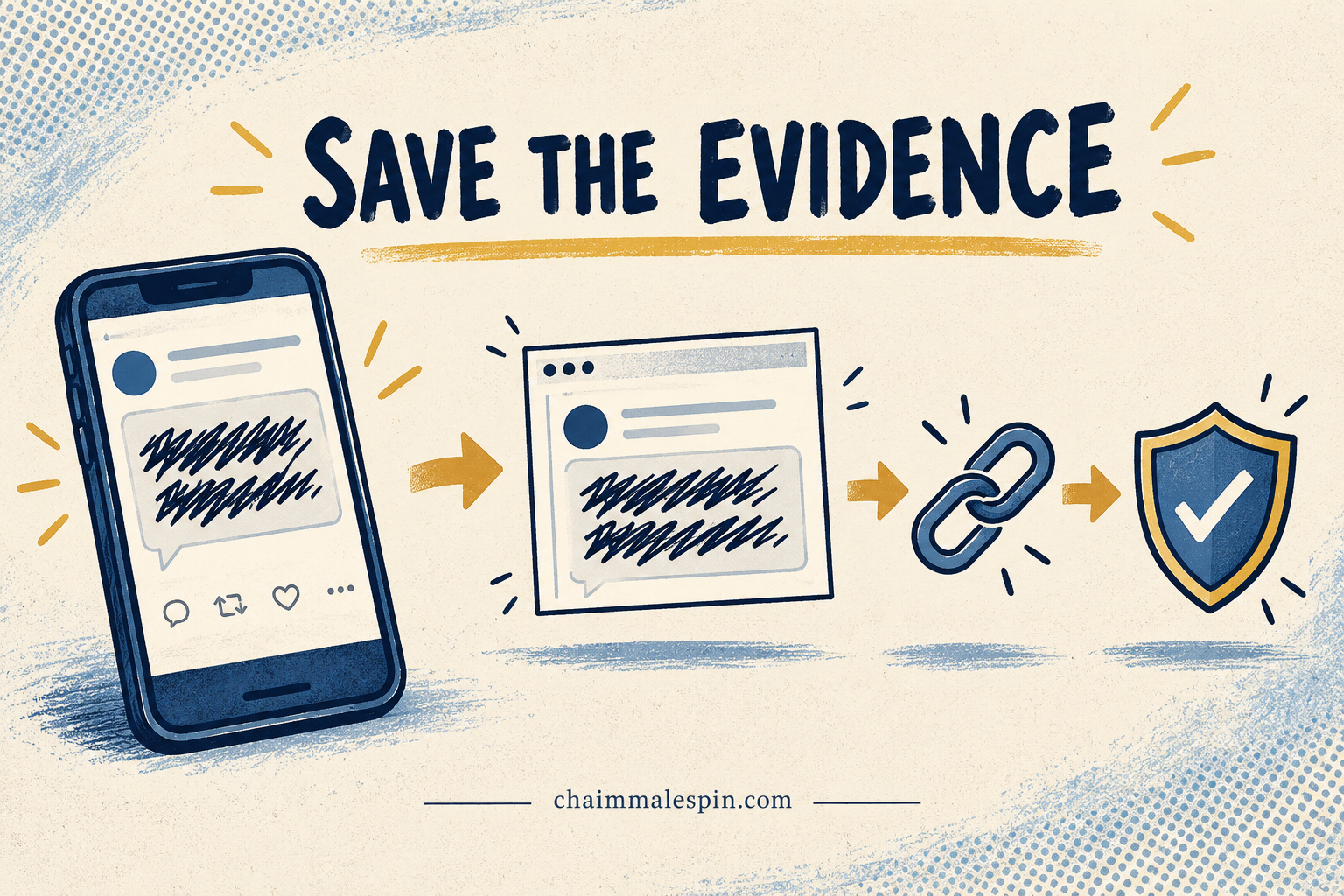
If the post involves harassment, threats, impersonation, doxxing, or repeated targeting, preserve the evidence before blocking the account or asking the platform to remove it.
Take screenshots that show the full post, username, date, time, and surrounding context. Save the direct link and record the platform. If the behavior continues, keep a simple timeline. PEN America's Online Harassment Field Manual explains that documentation can be essential when reporting abuse to a platform, employer, school, lawyer, or law enforcement. [1]
Store the evidence somewhere secure. Avoid publicly reposting personal addresses, phone numbers, or other sensitive information while trying to expose the harasser.
Not every antisemitic post deserves your reply. Engagement can educate people who are watching, but it can also reward a hostile account with attention and algorithmic reach.
Consider responding when the person appears reachable, the claim is specific, and your answer could help a wider audience. Keep the response focused: identify the claim, explain why it is false or harmful, and provide one credible source.
Disengage when the account is threatening, repeatedly abusive, or clearly uninterested in good-faith conversation. ADL's guidance distinguishes between constructive engagement and situations where blocking, muting, reporting, or stepping away is safer and more useful. [2]
You do not owe unlimited access to anyone who targets you.
When you do engage, precision is more persuasive than a broad accusation. Instead of writing only, 'You are an antisemite,' name the specific problem: 'That claim repeats the conspiracy that Jews control the media,' or, 'You are holding every Jewish person responsible for a government's decisions.'
Ask a question when it can open space for reflection: 'What evidence supports that claim?' 'Would you apply the same standard to another group?' 'Are you criticizing a policy, or assigning guilt based on identity?'
Keep your language factual and avoid humiliation. The goal is not necessarily to convince the original poster. It may be to give everyone else reading the exchange a clearer framework.
Use the platform's reporting tools and choose the category that best fits the content, such as hate speech, harassment, threats, impersonation, or disclosure of private information. Include links and screenshots when the reporting form allows them.
If the incident involves a workplace, school, university, or professional organization, report it through the relevant internal channel as well. Describe what happened, when it happened, who was targeted, and what action you are requesting. Avoid assuming that one report automatically reaches every responsible department.
Platform systems are imperfect, but reporting creates a record and can lead to content removal or account restrictions. PEN America and ADL both recommend documenting content and reporting it to the platform of origin. [3] [4]
A threat of violence, stalking, swatting, or the publication of private location information should not be handled as an ordinary comment-section disagreement.
Preserve the evidence, tell a trusted person or organizational security contact, and contact the appropriate local authorities when there is a credible or immediate danger. The FBI's threat guidance for readers in the United States recommends preserving electronic evidence and reporting threats to law enforcement; readers elsewhere should use their local emergency and cybercrime channels. [5]
Do not confront a threatening person in private, reveal your location, or announce every protective step publicly. If you are in immediate danger, contact emergency services where you live. This article provides general information, not legal advice.
If someone else is being targeted, ask what support they want before amplifying the incident. They may need help documenting reports, moderating comments, contacting an institution, or simply not facing the abuse alone.
Do not repost hateful content without a clear purpose. Repetition can expose the target to more abuse and give the original message a larger audience. If sharing is necessary, remove personal information and consider obscuring slurs or account names.
Online hate can be exhausting even when it is not directed at you. Take breaks, mute keywords, limit notifications, and ask others to help monitor a difficult thread. Requesting support is part of a responsible response, not a failure to be strong. [6]
Do not share unverified screenshots as fact. Do not organize a pile-on against a private individual. Do not expose someone's personal information. Do not continue an exchange that is making the situation more dangerous. And do not confuse visibility with impact: a viral argument may feel satisfying while doing little to help the person targeted.
UNESCO emphasizes accurate knowledge, critical thinking, and media literacy when countering online hate and Holocaust distortion. Verification matters because false or careless claims weaken our credibility and can deepen the same information disorder we are trying to challenge. [7]
Assess: Is this ignorance, misinformation, harassment, or a threat?
Document: Save the post, link, account details, date, and context.
Choose: Engage, report, block, or escalate based on the risk.
Respond: Be specific, factual, and proportionate.
Support: Center the needs and safety of the person targeted.
Review: Protect your privacy and emotional capacity before continuing.
Antisemitism spreads when it goes unchallenged, but challenging it does not mean answering every provocation. A purposeful response protects people, preserves evidence, corrects falsehoods, and chooses the action most likely to help.
Sometimes that means speaking publicly. Sometimes it means reporting quietly. Sometimes it means supporting someone offline. The important thing is to respond with clarity instead of allowing the harasser to control the terms of the conversation.
For more practical resources on antisemitism, Jewish life, and advocacy, join my email community and receive new articles directly.|
Sources
1. PEN America — Documenting Online Harassment
2. ADL — Tips for Engaging and Disengaging on Social Media
3. PEN America — Reporting Online Harassment to Platforms
4. ADL — Online Hate and Harassment Safety Guide
5. Federal Bureau of Investigation — Threat Intimidation Guide
6. PEN America — Requesting and Providing Support
7. UNESCO — Addressing Holocaust Denial and Distortion